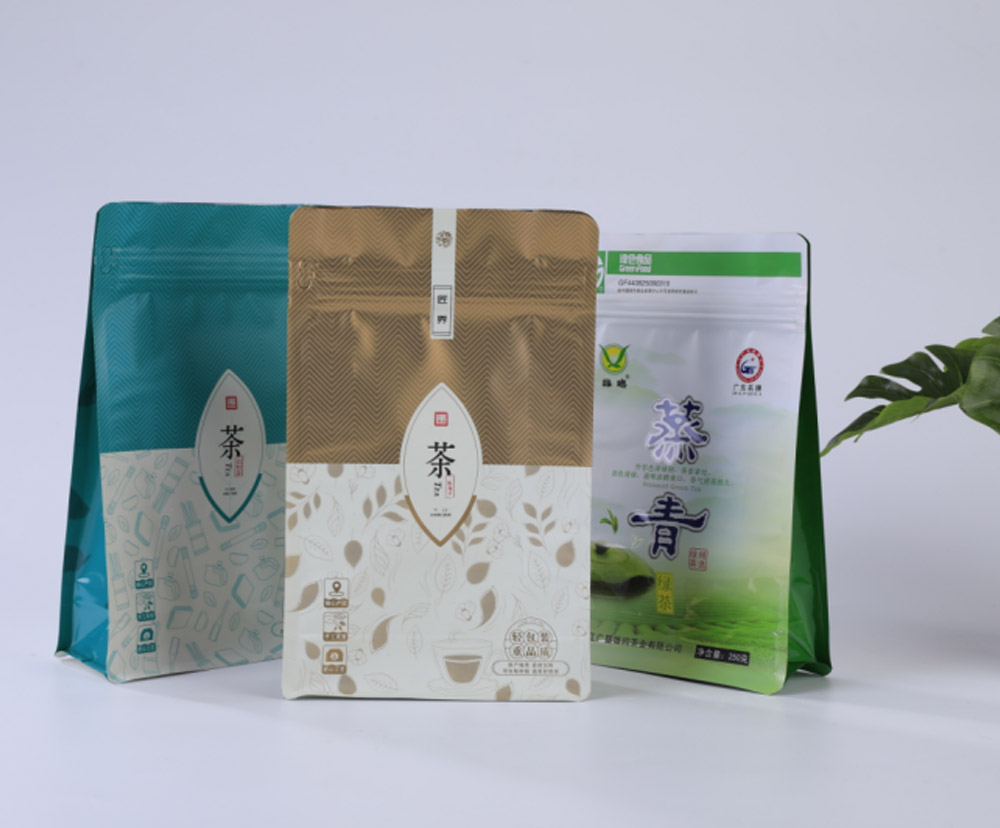
Both formats stand on a shelf. The difference is how they get there, what they cost, and what happens when a pallet of them arrives at a distribution centre.
Material and cost
A flat-bottom pouch uses more film per pack than a doypack of the same fill volume — typically 10 to 20% more, because of the base construction and the four side panels. The bag-making cycle is also slower, since the base has to be folded and sealed in a separate station. On a like-for-like structure, the box pouch is the more expensive pack.
Shelf presence
The box pouch prints on five faces. In a category where every competitor is a doypack, that extra panel is a genuine differentiator: the side panels carry copy that the front cannot hold without clutter. The doypack's curved face, by contrast, distorts print near the edges.
Pallet efficiency and stability
This is where the box pouch wins decisively. A flat base stacks squarely, so a pallet is stable without a display tray and the case count per pallet is predictable. Doypacks lean, which is why they are usually shipped in a tray or a shelf-ready case — an extra cost that is easy to forget when comparing pack prices.
Line speed
Doypack machines run faster than flat-bottom machines on the same film. If the line is capacity-constrained, that difference can outweigh the material saving.
When the doypack is the right answer
- Fill weights under 500 g, where the base stability advantage is small.
- Categories where the curved face is the established convention.
- Projects where the machine already exists and the format cannot change.
When the box pouch is the right answer
- 1 kg and above, where a stable base actually matters on shelf.
- Premium coffee and pet food, where the side panels carry the brand story.
- Markets where shelf-ready packaging is required by the retailer.
The third option nobody quotes
A doypack with a wider bottom gusset gets most of the stability at doypack cost. It is the compromise most projects end up at, and it is worth asking for before committing to either extreme.
How to compare the two costs honestly
The pack price is the number everyone compares, and it is the least useful one. A fair comparison adds four things:
- Film per pack — a box pouch uses more, typically 10–20% at the same fill volume.
- Case and tray — doypacks usually ship in a tray or shelf-ready case; box pouches often do not.
- Pallet yield — how many units fit a pallet, and whether the pallet needs a slip sheet to stay stable.
- Line time — the bag-making cycle is slower for a box pouch, and that is a cost even when it does not appear on the invoice.
Add those and the gap between the two formats usually narrows to a few percent — which is why the decision should be made on shelf performance, not on pack price alone.
When the retailer decides for you
In most developed grocery markets the format is not entirely the brand's choice. Shelf-ready packaging requirements, planogram heights and peg versus shelf rules all constrain it. A box pouch that stacks squarely is easier to merchandise; a doypack that leans needs a tray, and the tray has to fit the shelf depth.
The practical move is to ask the buyer two questions before the structural decision: what is the shelf depth, and is a tray acceptable. The answers eliminate one of the two formats faster than any cost model.
Migrating between formats
Brands rarely switch in one step. The usual path is doypack to wide-gusset doypack to flat-bottom, taken over two or three seasons as the print cylinders come up for renewal. Doing it that way spreads the cylinder cost and lets the packing line be adjusted between steps.
The step that catches people is the middle one: a wide-gusset doypack needs a different forming set and often a different fill opening, and the artwork has to be re-laid to the new panel proportions.
The question to ask before either
Before choosing a format, answer one question: what does the pack have to do on the shelf that the product cannot do for itself? A premium coffee at a €12 price point needs to look like a €12 pack; a 10 kg kibble bag needs to survive a pallet and stand upright in a warehouse aisle. Those two answers point at different formats, and neither is decided by film cost.
It is also worth checking the fill opening. A flat-bottom pouch has a wider top opening than a doypack of the same volume, which matters if the product is filled by a volumetric filler with a large spout, or if the line is manual.
One more cost that never appears on a quotation: the learning curve. A packing team that has run doypacks for ten years will run a doypack line faster from day one, and the first production runs of a new format always cost more per pack than the steady state.